The Inception of Selestium Astrology
A few months ago I decided to finally invest in a professional-grade astrology program that would also help support my learning and practice within constellational sidereal astrology. Unfortunately I wasn't able to purchase that software for a multitude of reasons beyond my control, and because of that, months later, I now have the beginnings of a professional-grade astrology program that supports tropical, sidereal, and constellational sidereal astrology.
I will have more to say in the near future about the circumstances and philosophy behind this choice to develop my own software, but for the moment I merely want to note a few things that I think already make Selestium Astrology relatively unique among existing astrology software.
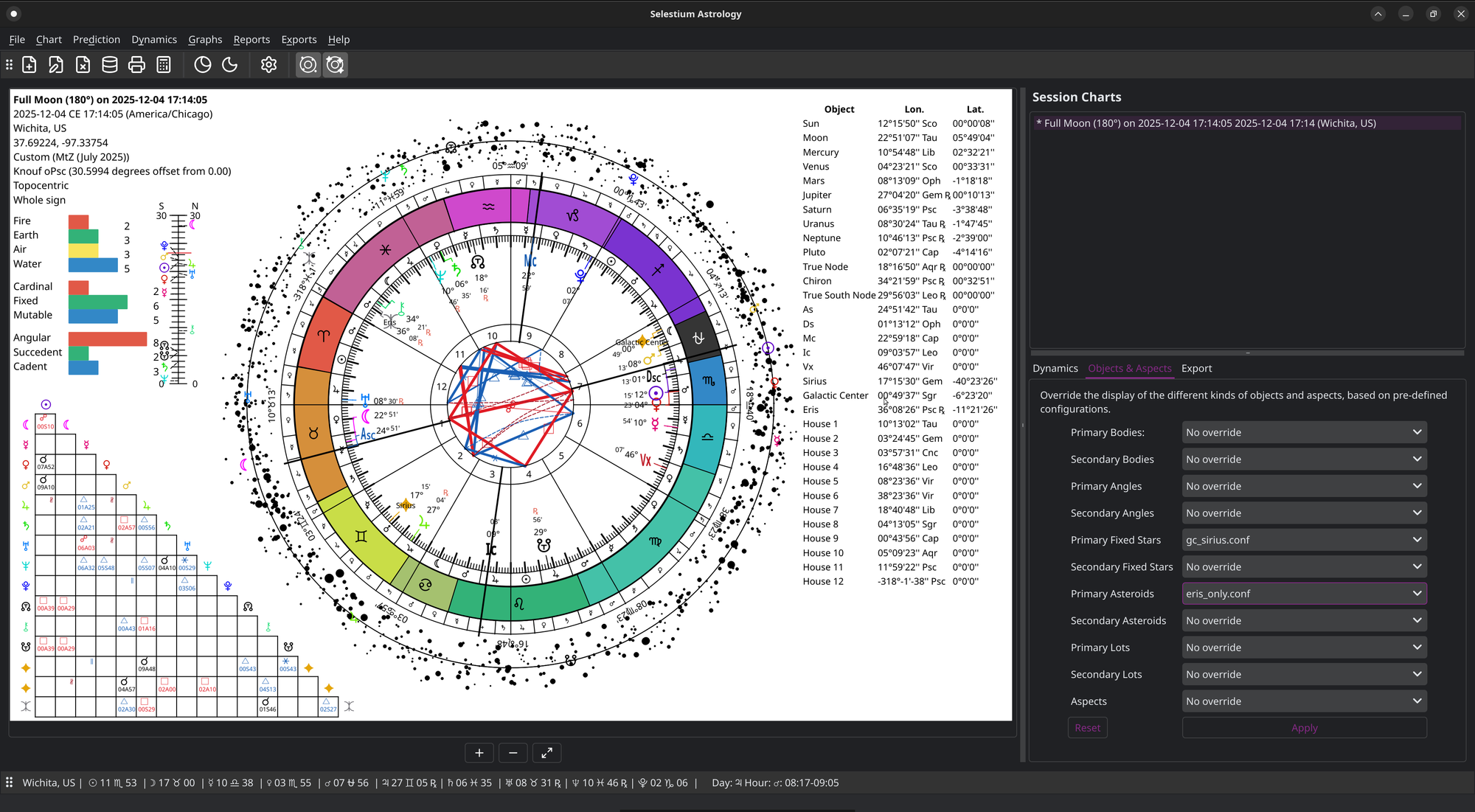
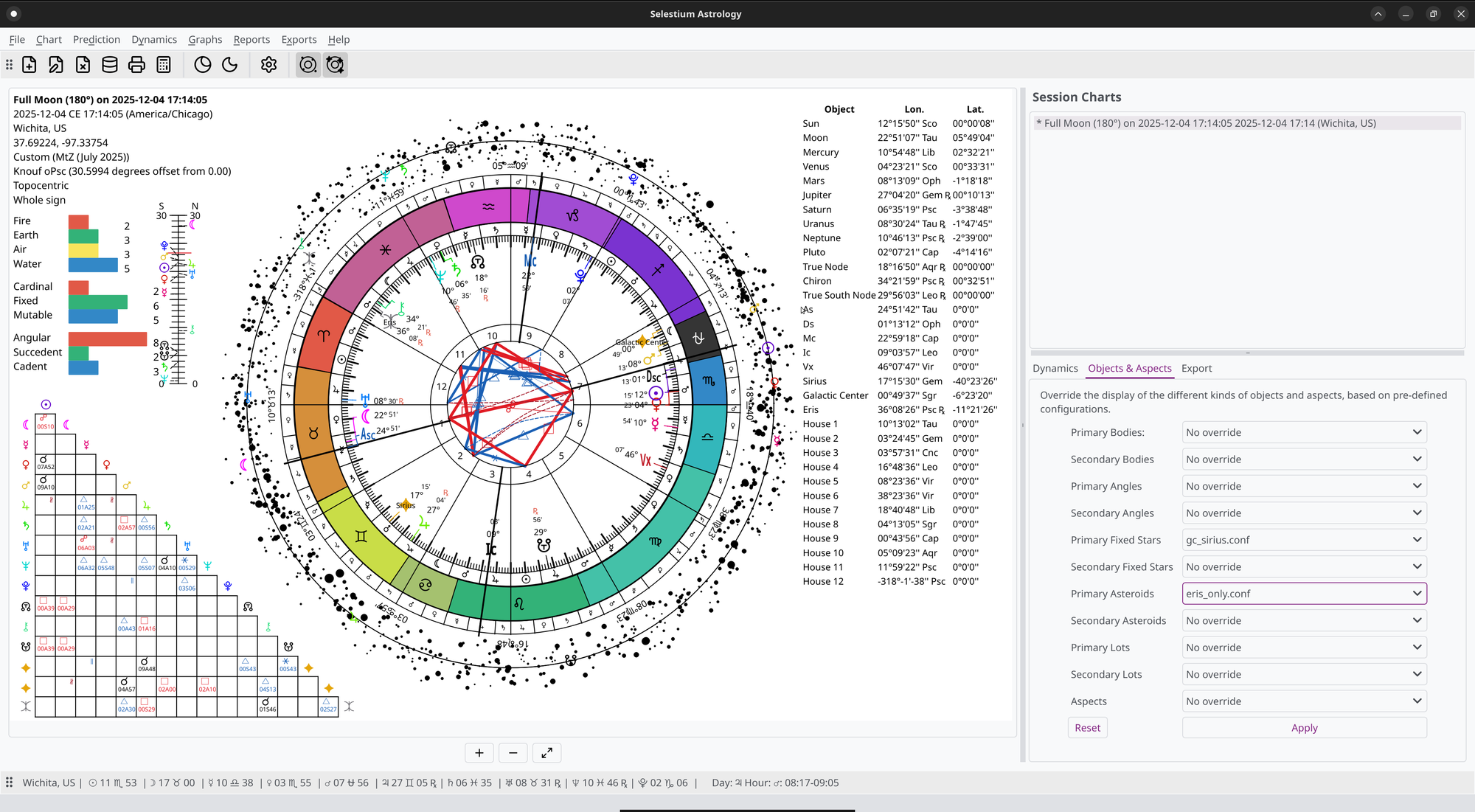
Selestium Astrology interface showing dark and light modes, showing a chart for the new moon on 4 December 2025. This also shows Selestium Astrology running on Ubuntu Linux 24.04 using LXDE.
First off, Selestium Astrology has been built from the ground-up to be supportive of constellational sidereal astrology. You will be able to define any number of divisions of the zodiac into what I call zodiac sectors (which we commonly call signs, but perhaps can also, in the future, be understood to be more general than this). These sectors can be any size. This means that if you want to explore a 19-division unequal zodiac (for some reason) you can!
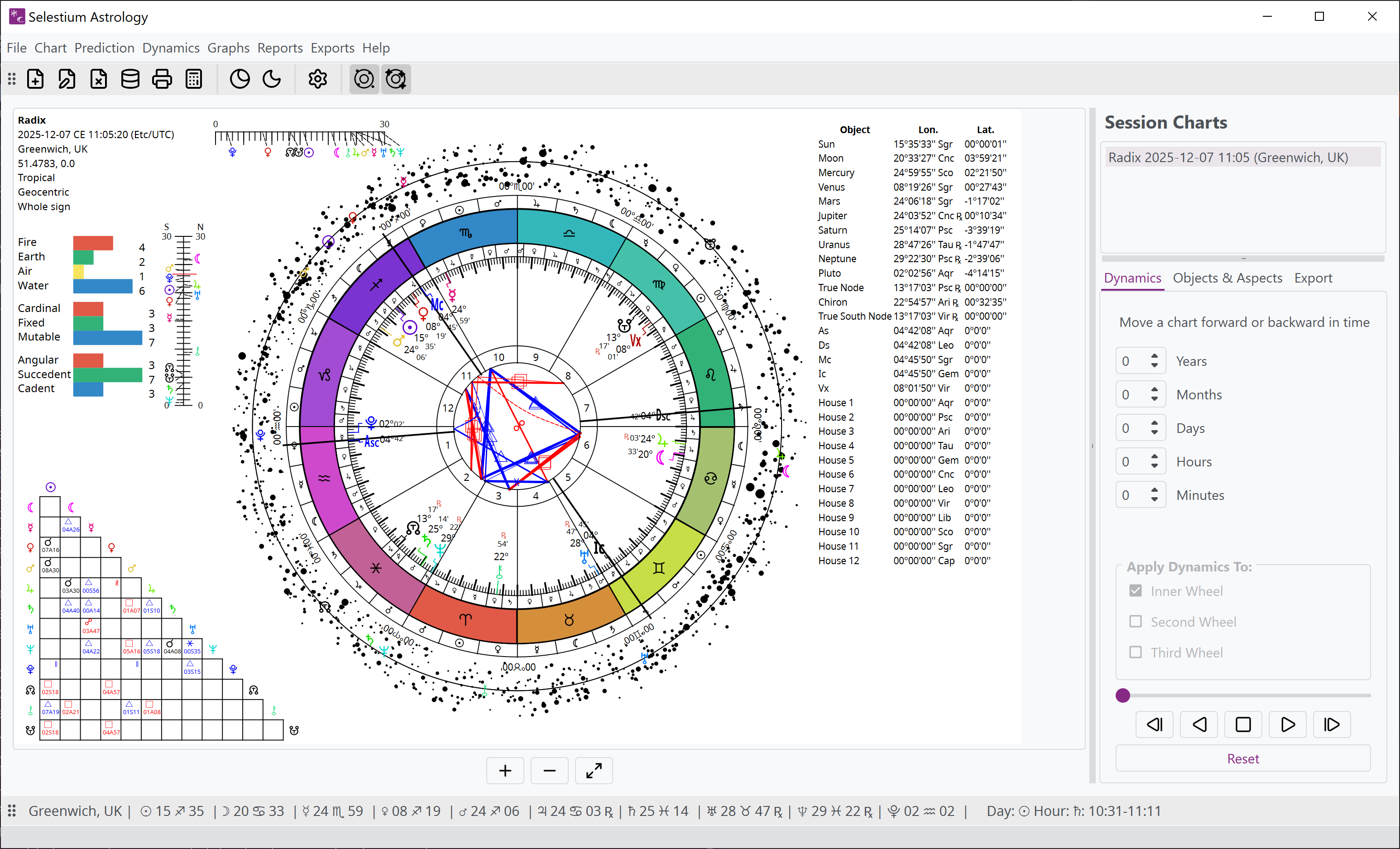
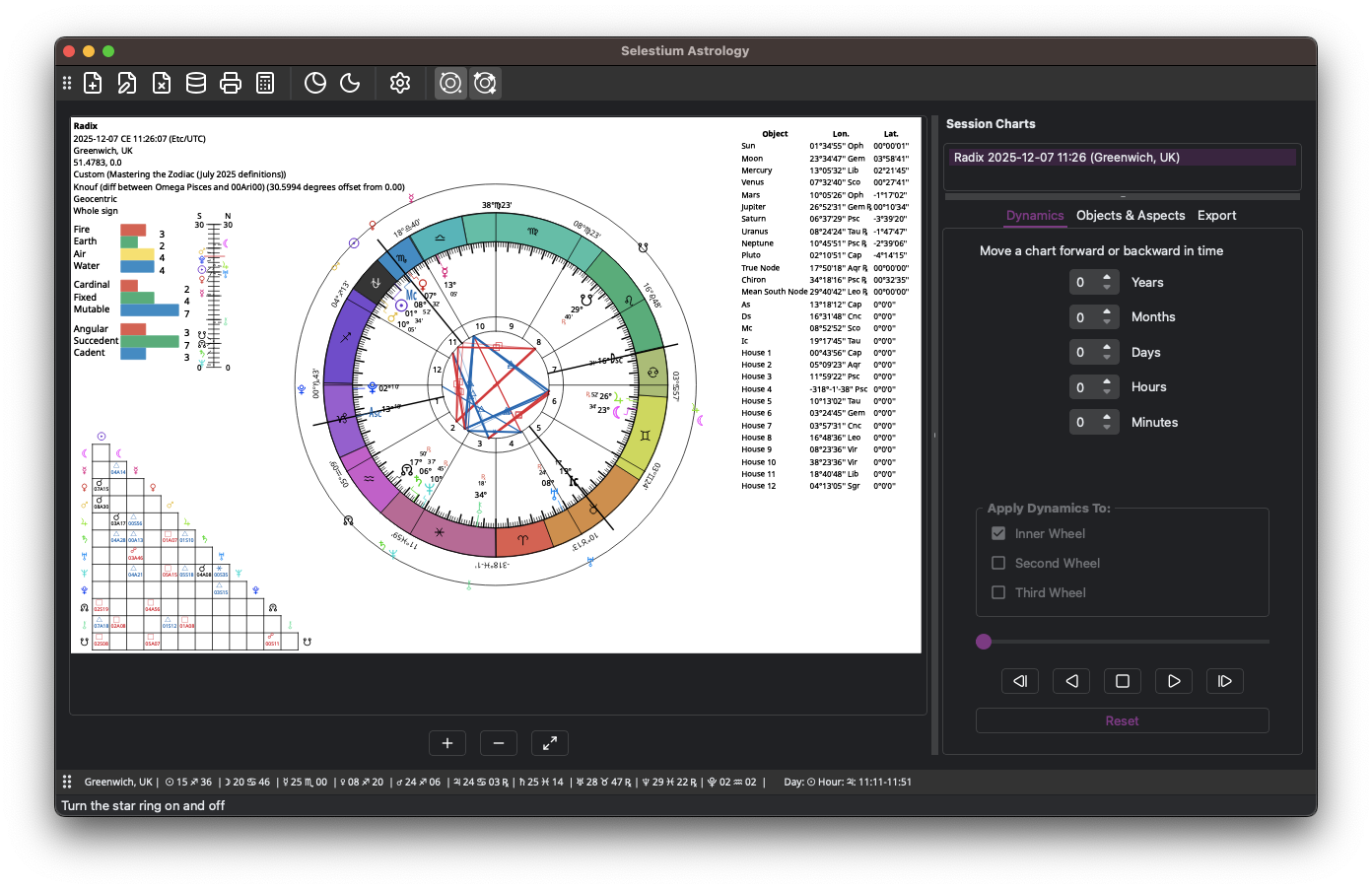
Examples of Selestium Astrology running on Windows 10 (left) and MacOS Ventura (right). The MacOS version in particular needs some work with respect to text rendering, but the functionality of the software is identical across platforms.
Once you've defined this zodiac definition, you can also define any arbitrary offset of the zodiac from the tropical zodiac. This allows those of us interested in constellational sidereal astrology to more precisely align the unequal zodiac with the sky that we observe. Importantly, there is no fundamental link between the zodiac divisions and the zodiac offset, thus allowing you to easily play around and explore how different offsets affect the placement of objects in the chart.
Second, Selestium Astrology is designed to be cross-platform. I develop the software in Linux and have tested it extensively there and in Windows. MacOS testing will begin shortly. Unfortunately Selestium Astrology does not run on Android or iOS, nor does it run on the web. This choice is made for a number of reasons which I will explain in the future.
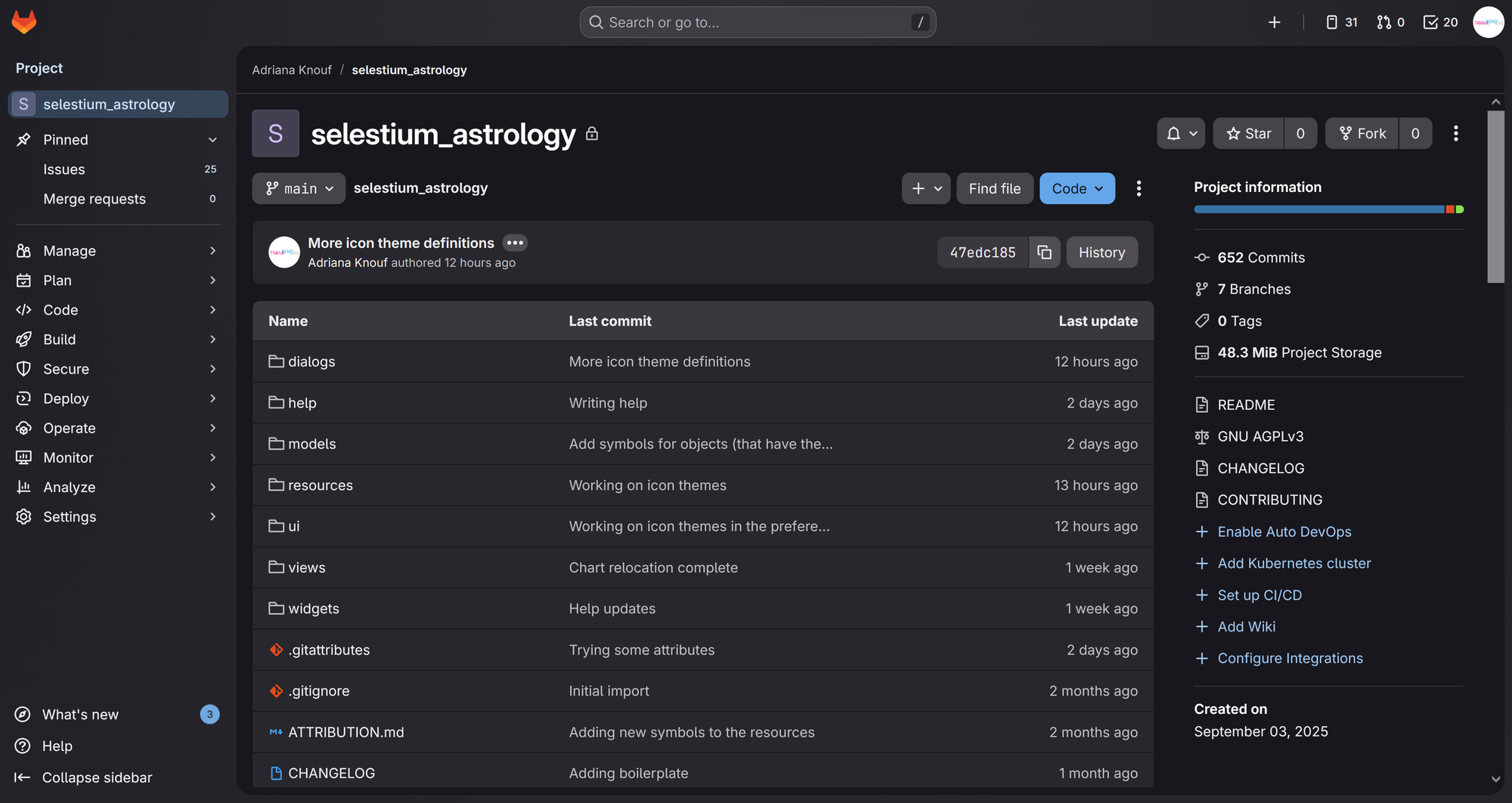
Third, Selestium Astrology will be fully open-source. This includes not only the code for the software itself, but also the file formats for the charts. Nevertheless, in order to fund the development of the software, I will not be making compiled versions of the software available for free; those will require purchasing a license. (Think of the source code as the raw material of the program, which if you are a developer yourself you can probably figure out how to run for free. The "compiled version" of the software is what you would normally download from a company's website and oftentimes purchase a license to run.) I think this is a fair division between wanting to make my work open to the community, but also allowing some remuneration of my work that can go towards further developing the program. The license will be a perpetual license; no license servers, no yearly subscription fee—only a one-time charge. Selestium Astrology will be priced competitively.
I fully believe in an open-source ethos as that is where I have come from in my own practice as an artist who works with technology as well as a software developer. In addition, many also forget (or do not know!) that the software that provides all of the chart calculations for astrologers, the Swiss Ephemeris, is itself open-source. I will have a lot more to say about this in the near future.
Finally, while I have much practical experience with AI over the past few decades of my career as a technological artist (more information about that can be found on my website tranxxeno lab), Selestium Astrology has been coded without the use of any AI. No vibe coding here! No sharing of data with LLMs. Only a lot of effort as well as innumerable time spent in forums over the past few months.
There will be much more to share in the coming weeks, especially as I put the final touches on a pre-alpha version of the software that will be available for testing by the intrepid who want to explore the bleeding edge. I'll share soon some demo videos of the software as well.
Right now here are some (not all!) of the completed features:
- Customizable zodiacs (as described above), ayanamshas (for sidereal zodiacs), houses, rulership definitions, decans, and terms
- Predictions of eclipses, moon phases, and heliacal rising/settings (and morning last/evening first)
- Biwheels for transits, basic progressions; triwheels almost complete
- Return calculations for the traditional planets
- Relocation of charts
- Full dynamics of time and chart configuration
- Ephemerides (tabular and graphical)
- Graphs of ecliptic latitude and declination for a chart (with drawing of parallel/contraparallel lines)
- Both the graphs and the ephemerides are responsive to the default zodiac, so if you're using a custom, constellational zodiac the positions are calculated with respect to that zodiac
- 24 different aspect types (as well as parallel and contraparallel)
- Antiscia and contraantiscia points
- Unique ecliptic ring showing the position of a body above or below the ecliptic
- Unique star ring that shows the fixed stars above or below the ecliptic
- Extensive tool tips that provide contextual information
- Customizable colors for nearly all aspects of the interface
Please follow us on the socials on Mastodon (https://c.im/@selestium_astrology) and Bluesky (https://bsky.app/profile/selestium-astro.bsky.social).
Thanks for your interest! And more to come.
Keep a watch on the Selestium Astrology website (https://astrology.selestium.net) as I plan for a soft-launch of the pre-alpha version in the coming weeks.